



In the modern world, the impact of cervical osteochondrosis cannot be underestimated.Osteochondrosis in the neck is more common than in other vertebral areas.Almost everyone over the age of twenty-five suffers from this disease to one degree or another.
Cervical osteochondrosis occurs primarily as a result of a sedentary lifestyle, especially facilitated by a person's historical transition from physical to mental work, although this transition is to some extent accompanied by working in a seated position.
Cervical osteochondrosis is a degenerative dystrophic disease of the cervical spine that results in disc damage that is common with osteochondrosis.Since this part of the spine is quite flexible in nature but fragile due to underdeveloped muscle corsets, any negative impact on the neck or back will have a negative impact primarily on the cervical spine.Since degenerative changes occur most often in the most mobile vertebral regions, in the cervical region, the nerve endings at the C5...C7 levels are most commonly affected.
Because the symptoms of cervical osteochondrosis are very contradictory, they are not always considered solely as symptoms of the disease, which often leads to seeking help from specialists in other medical fields.Let's look at them in more detail.
Cervical osteochondrosis and its symptoms
Because the cervical spine is quite compact compared to other parts, even slight tension in the neck muscles or displacement of the cervical spine can cause nerve roots to be compressed or squeezed, which can also affect the blood vessels located in that part.Well, osteophytes - bone growths, known in folk remedies as "salt deposits", are formed during the development of osteochondrosis of the cervical spine, as a result of which they can only lead to a significant worsening of the disease process.
The clinical manifestations of cervical osteochondrosis, that is, its symptoms, can be divided into reflex symptoms and nerve root symptoms of cervical osteochondrosis.
Reflex symptoms of cervical osteochondrosis
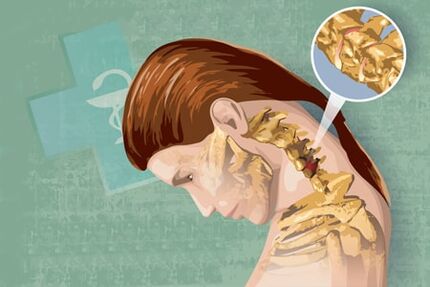
Reflex symptoms of cervical osteochondrosis include so-called "low back pain," which is characterized by severe, acute pain in the neck that is significantly aggravated by any movement.For this reason, patients often adopt some forced, most comfortable head position.Additionally, the typical "crunching" sound is likely to occur during turns or other head movements.
When suffering from cervical osteochondrosis, patients often experience pressure headaches that radiate to the eyeballs or the temporal part of the head.Additionally, sometimes the acuity of visual perception may decrease, as if "everything is floating before your eyes."
Vertebral artery syndrome also occurs when the nerve plexus is irritated, which is often misdiagnosed as a cerebral circulatory disorder because the patient is dizzy.This symptom of cervical osteochondrosis manifests itself as sudden movements of the head, accompanied by nausea and possible vomiting.
In addition to the above, reflex symptoms of cervical osteochondrosis include cardiac syndrome, which is a feeling similar to an angina pectoris attack.However, this symptomatic presentation of osteochondrosis is usually combined with other symptoms of the disease and therefore does not usually pose a difficulty in correct diagnosis.
Radical symptoms of cervical osteochondrosis
Typically, radicular symptoms of cervical osteochondrosis occur due to compression of the nerve endings (roots) of the spinal cord.In this case, the sensory impairment affecting motor function depends entirely on which specific nerve root is injured, i.e.:
- C1 – Decreased sensitivity in the occipital region;
- C2 - Pain in the parietal or occipital region of the head;
- C3 – Impaired sensitivity and pain in the neck area, injury to the roots of the spinal cord, possible impairment of speech due to loss of tongue sensitivity and its ability to control;
- C4 – Pain and decreased sensitivity in the dorsal scapula area, as well as heart and liver pain, along with decreased neck muscle tone, which may lead to respiratory dysfunction;
- C5 – Decreased sensitivity and pain on the outer surface of the shoulder;
- C6 - Pain radiates from the cervical spine to the scapula, outer surface of the humerus, forearm, and further from the wrist to the thumb;
- C7 - Same pain as C6, but radiating from the scapula to the posterior surface of the humerus and further from the forearm to 2 to 4 fingers of the hand, with reduced sensitivity in the painful area;
- C8 – Decreased sensitivity and pain from the neck to the shoulder and then from the forearm to the pinky finger.
Cervical osteochondrosis and its treatment

Cervical osteochondrosis is a rather complex and extremely unpleasant disease, and its treatment needs to be systematic, continuous and staged.Treatment of cervical osteochondrosis is primarily aimed at completely stopping the painful symptoms of cervical osteochondrosis and eliminating inflammation in the neck affected by the disease.
Patients treated for cervical osteochondrosis were treated with classic analgesics.Although in recent years, non-steroidal anti-inflammatory drugs, which are effective in relieving pain and reducing inflammatory activity, have become widely popular in the treatment of cervical osteochondrosis.
In addition to this, in the treatment of osteochondrosis of the cervical spine, chondroprotectants are used, which slow down the process of destruction of cartilage tissue and, according to many experts, also contribute to its regeneration process.In addition, doctors also give patients B vitamins to improve metabolic processes in the patient's body.
However, using external gels or ointments to treat osteochondrosis of the cervical spine, while less effective, makes sense because of the additional massage of the cervical spine during rubbing them into the skin.
Physiotherapy also combines traditional medications to treat cervical osteochondrosis, especially the use of magnetic therapy through special treatment devices, which is particularly effective.In addition to the treatments mentioned above, therapeutic massage, physiotherapy and manual therapy are also used.However, in particularly severe cases, surgical intervention may be necessary.
Prevention of cervical osteochondrosis
The prevention of cervical osteochondrosis itself is not difficult.recommend:
- Maintain an active and healthy lifestyle,
- Do some exercise, or at least morning exercise,
- the competent organization in the workplace,
- Follow the work and rest schedule,
- When sitting for long periods of time at work - During working hours, do a few warm-up exercises and ensure correct head position and posture while working.
It’s also important to choose comfortable sleeping pillows and mattresses.But for those who already suffer from this condition, daily use of specialized orthopedic products is highly recommended for a comfortable sleep.